Saturday, January 10, 2015

Subaru Impreza (Part 1)

At first sight, there is nothing special. The car has typical shapes for a modern vehicle. But there are a few characteristic details that give the “Impreza” a particular expressiveness. The large “nostril” of the intercooler in the center of the hood, the massive spoiler on the trunk and the huge and rough fog lights in the front bumper call from your subconscious such names as “Paris-Dakar Rally”, “Pharaons Rally” and “Monte Carlo Rally”. While testing the car, I had an obsessive feeling, as if it was not just a car, but a breathing creature with a powerful charge of energy. When I first saw this car, my legs were trembling  with inexplicable fear-  it sent a chill down my spine- I was filled with turbulent emotions until the door opened and I got into the car.


My first impression of the interior was slightly discouraging- the finishing seemed to be slightly primitive with its dark tones. The number of devices and all kinds of knobs and buttons is minimized, but after a more careful study, I understood that everything was optimized to achieve the most important goal: the maximization of the driver’s contact with the car. The interior is poor, or to be more correct, it’s realized in an ascetic style, thus creating an atmosphere of maximal energy concentration and attention to handle the car. Speed is the paramount feature of the “Impreza”, therefore on the main site you can see the excellently visible and easily read speedometer, tachometer, fuel and temperature gauges, which help the driver to control the movement and the speed of the car. The lights devices are controlled by means of the switch on the right sight of the steering wheel, so the driver needn’t remove the hand from the steering wheel to manipulate them- just pull the fingers! The same is with the mirrors and windows controls.


The “Recaro” anatomical seats are rather hard, but let’s not forget that this vehicle is not created for comfort.
I turned the key and the car came alive.  When the pointer of the tachometer crossed the cherished mark “3000”, there came the moment of truth- I understood the reason of that fear, when I first saw the car. As the turbine started to howl, I literally got stuck in the seat. From passengers’ side, I could hear hysterical exclamations, which are impossible to reproduce for censorship reasons.
To be continued...

Monday, December 22, 2014

Hyundai Tuscani

Hyundai Tuscani is a modern car with a great performance and quite affordable price. Translated from Spanish, the word “Tuscani” means shark,- and indeed, the smooth profile and “gills” on the fenders really make the car look like the predator. In addition to the unique appearance, the “Tuscani” is distinguishable from its Hyundai-fellows by a 2.7-liter engine capable of producing 172 HP, bifurcated exhaust pipe, which slightly increases the engine power, and more sophisticated interior equipment.


In Armenia, Hyundai Tuscani is available in two versions: with 2L 4-cyliner engine with a capacity of 143HP and 2.7L V6 engine with a capacity of 172HP. Although these two versions are equipped with different engines, they share the same set of standard options: central locking, air conditioning, disk brakes on all wheels, air bags and split exhaust pipes made of chromium. The car is very attractive from every side and has a very modern appearance. The smooth body lines adds elegance to the model, which makes it distinguishable from other coupes. In the images, the “Tuscany” looks slightly bigger, but in reality, it’s quite compact and has a low height. The features of Hyundai Tuscani allow the car to be easily considered as a roadster, because the rear window (along with the trunk lid) is actually the third door.


This car is also attractive on the inside. Compared with Hyundai Tiburon, the “Tuscani” has got quite a different interior. The dashboard now has a new appearance- it is equipped with an odometer, the indications of which are shown on an electronic display. The panel is stretched along the length of the cabin- it is divided by two holes of the heating system and control buttons. The stereo system is located in the center of the console panel with the adjustment knobs of the heating system and air conditioning.
The handle of the gearshift has not only a short stroke, but also a comfy location, so the driver can make a smooth shifting at any time. The seats of the “Tuscani” have scoop-like shape and are very comfortable.
The interior trimming is made of high-quality fabric, which keeps the salon warm in winter and cool in summer.  The “Tuscani” has four seats. The back seats would be more appropriate for children and can additionally be used as a storage place.

Specifications of Hyundai Tuscani 2.7: 

Length-4395mm, width-1760mm, height-1330mm.
Maximal weight- 1740kg
Engine-V6
Engine capacity- 172HP/6000
Maximal torque- 245 N m/4000
Maximal speed 220km/h
Transmission- manual  6-speed.
Fuel consumption per 100km- 10.3-10.4L
Fuel tank volume- 55L

Wednesday, December 10, 2014

Skoda Superb (Part 2)

In spite of the fact that the base of the ‘Superb’ is shorter by a couple of centimeters than that of the previous model, it’s still quite spacious inside the car, and this is partly due to the transverse replacement of the engine. If you've ever driven a VW, you won’t have to get used to Skoda.


There are plenty of knobs and buttons, the locations of which are more than predictable- the ergonomics allows to guess everything intuitively. The panel is simple and unobtrusive- it has nothing to surprise the passengers, which I think is for good.
The wheel and gearshift are wrapped with leather. If you want everything else to be covered with leather, you’ll have to pay extra. But even without leather, the interior looks expensive and presentable- there is no hint of cheap Chinese plastic.


The power train is supported by 6-speed DSG gearbox (with twin-clutch plates), which pleasantly surprised me- it works amazingly fast. The 1.5-ton Sedan with DSG gearbox manages to accelerate 0-100 km/h in 8.5 seconds, while the one with manual gearbox does it in 8.6 seconds.
The mode “D” was more than comfortable, but I preferred to drive on the “S”- it wasn't a true sports mode- the behavior of the car becomes slightly sharper.
Someone might think that a 1.8-liter engine is too small for a business sedan- but no, the engine, indeed, demonstrated good dynamics.

The fuel consumption is less than 13 liters in the city. When I took the car, it had a full tank- I drove almost 500 kilometers for two days and there was still plenty of fuel left in the tank.
It’s great pleasure to ride in this car- the excellent sound insulation saves the passengers from the roar of the engine and aerodynamic howls. Both at high and low speeds, all the road junctions and roughness are ignored; the suspension is capable of coping with even bigger road holes and bumps, so that the passengers may only guess that there was something, but nothing special.
"Skoda Superb" is not created for young people- it would be more suitable for those who once got attached to affordable "Octavias" and "Felicias", but has since grown in age and status. But in spite of the fact that I was still fresh and young, I enjoyed driving the “superb” very much.

Tuesday, December 2, 2014

Skoda Superb (Part 1)

I managed to get a wonderful car for a couple of days- the Skoda Superb of second generation. Not long ago, I spent a whole day riding in it as, and I loved it very much. The car belonged to a friend of mine and I decided not to miss the opportunity to put it to the test.


In Armenia, this car is available in three versions- two of them (manual and automatic) have a 1.8-liter petrol engine with a capacity of 152 HP, and the third is equipped with 2-liter 140 HP diesel engine with automatic gearbox.  All these engines are turbocharged and are called TDI (Turbo Diesel Injection) and TSI (Turbo Stratified Injection)- everything like in blood brother VW. Each of the models is available in three versions-Comfort, Ambition and Elegance. Perhaps, I got the most interesting model, the 152HP-Elegance with a robotized DSG gearbox. I am not a connoisseur of automotive design and, without going into the prehistory of this model, I will say that Skoda Superb is something quite different from what the company manufactured before.  The car has a unique design and recognizable image. The unusual shape of the headlights and massive black grille give the car aggressive appearance, which is emphasized by the bonnet relief. 
The side view is not so interesting- there is nothing special to attract somebody’s attention- simple and with taste. But… if you take a good look, the elongated roof shapes stretching down to the rear rack start to remind you of Bentley Continental Flying Spur. The designers of Skoda seem to have inspired in the right place.


The back appearance is less expressive- could be done better. But in general, it’s pretty, I like it.
The "Superb" is simply huge- throughout the whole test drive, I was trying to get used to the dimensions of the car, but I couldn't- only after the third attempt I managed to make a parallel parking in the yard. The Parktronic system (in my case, it was only on the back) wasn't much help. As for ‘Parking Assistant’, I wouldn't have trusted it, even if there had been any.
To be continued...

Friday, November 21, 2014

Mercedes-Benz CL 500 Lorinser

Mercedes-Benz CL 500- elegant design, 300 HP, high-quality leather and wood, electronic navigation, ABS, ESP- the list of features can be indefinitely continued. For true admirers of the CL 500, there seems to be only one model standing above in rank- the CL600. But the German tuning company Lorinser came up with an alternative by creating Mercedes-Benz CL 500 Lorinser. It is to mention that the CL has also been modernized by such giants as AMG, Brabus and Carlson.


There is a world of visual difference between the standard CL 500 and the one tuned by Lorinser. So, for instance, the front and back bumpers look more embracing, the fog lights have also changed, the car has been equipped with more aggressive wheels and  radiator grille. The new fenders, rear roofline and lip spoilers are the result of Lorinser’s aerodynamic solutions.
In general, the tuning has imparted subtlety, beauty and some sport features to the CL. The CL 500 Lorinser introduced in this article has undergone only external tuning. The suspension, power train as well as the saloon remained unchanged.
So, the 5L 306 HP V8 engine easily accelerates the car to 250 km/h (electronically limited). The maximal torque reaches 460 N m at 2700 RPM. The first thing to attract  (or to scare) passer-by is the triumphal engine roar produced through the branded silencer. But, thanks to the famous noise insulation by Mercedes, the noise is almost inaudible inside the car. According to factory data, the CL 500 accelerates from 0 to 100km/h in 6,5 seconds. In my hands, this 12-year-old CL accelerated to 100 km/h in only 7,1 seconds.


The braking system is highly reliable, since it is reinforced with powerful Brembo braking system, which can be seen through the 19-inch Lorinser wheels. In my test, the brakes showed high efficiency- the car fully stopped after 34 meters of braking distance.
By the way, the smooth running is supported with a 5-speed automatic gearbox, which can also be shifted manually. The preferred driving mode can be saved in the memory of the computer, which controls the transmission, after which the operation of the transmission is adapted to the selected mode.
As for interior, compared to the S-class sedan, there is no change- the same luxurious finishing, comfortable seats with heating and ventilation and the same informative dashboard. The positions of the seats, steering column, wing mirrors are electronically controlled and can be saved in the memory of the computer for three different drivers.

There is plenty of power, dynamics and stability to perform any kind of maneuvers in a dense stream of cars moving at high speeds. There is also enough maneuverability to park the car at tiny places. The interior is so comfortable that you will rest during the ride.
 During the ride, I never stopped amazing at how carefully every detail was thought out in this car. I had the impression that the car was able to guess and instantly fulfill every whim of the driver.
Undoubtedly, among all vehicles designed for active driving, the CL 500 Lorinser is one of the most appropriate options to fully meet the requirements of its owner.

Wednesday, November 12, 2014

The Enigmatic Car (Unrecognized Mercedes)

It is obvious that our today’s hero belongs to the family of Mercedes-Benz, but I find it rather difficult to make a deduction exactly which model it is.
The exact year of production of this "mysterious" Mercedes is unknown. The owner offered his version, but, having carefully examined the car, I couldn’t come to a certain conclusion on the production year.


The reason for that is that the car has undergone numerous changes at the hands of its previous owners. Before appearing in Armenia, the car must have been carelessly used somewhere in the Soviet Union after the World War II (I am more than sure that the car was brought to the USSR as a war trophy from Germany like many other retro miracles), and then it was shamelessly equipped with details and spare parts taken from soviet cars, so it altered beyond all recognition.
However, after much research, I found that there was a similar model manufactured between 1932 and 1937, which had various body modifications: a sedan, like our undiscovered hero, the Pullman (the elongated version of the sedan), coupe-cabriolet, “landole”, etc.


At first glance, our hero bears a strong resemblance to Mercedes-Benz 200 W21, which was first introduced at Berlin Motor Show in 1933, but at the same time, it also bears external resemblance to 260D model, which was also introduced at the same motor show as the first passenger vehicle with a diesel engine in 1936. I also learned that the 200 W21, in spite of being produced in large quantities (15622 samples), didn’t play a major role in the history of the German car manufacturer.
As for the D260, it was a “trailblazer” in the world of automotive industry. In the mid-thirties of the last century, not many people believed in the success of passenger cars with diesel engines, but time has shown quite the reverse- every second vehicle runs on diesel fuel nowadays.

When I found out that the first diesel engine car was built on the chassis of the 230 model, which was subsequently built on the chassis of the 200, I only then understood the reason of the similarity between our unknown Mercedes, the 200  W21 and the 260D. The 200 W21 was the most affordable and fuel-efficient car of its time, and the 230 was the petrol engine modification of the 200 W21.
It is impossible to even guess which engine the car was equipped with, diesel or petrol, since it underwent not only numerous external changes, but also external. There is nothing left from the original chassis either.
One thing for sure, this car belongs to the family of Mercedes-Benz, the members of which have always been the tops.

Wednesday, November 5, 2014

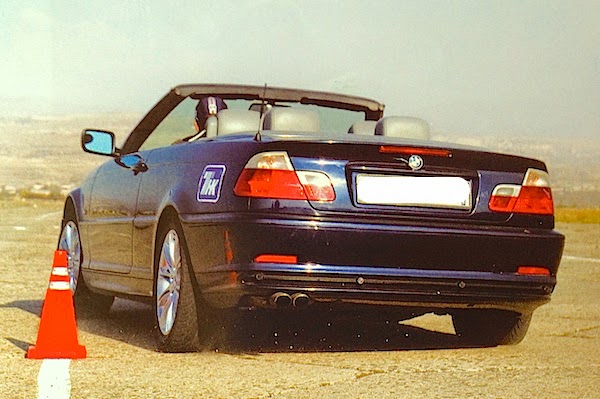
BMW 330Ci Cabriolet

Since the release of the first model in 1975, the BMW 3 series has become a unique and very popular car all over the world. The reason for this success is the combination of the best technical characteristics:  inline engine, rear wheel drive, a choice of manual or automatic transmission and independent suspension.
Over the years the concept of this model has not changed- a sports car for transportation of passengers and cargo.


This powerful “pile of muscles” is designed to meet the highest standards of accuracy, reliability and durability. The production of 3 series was launched in 1999. By the year 2001, there were already 10 models on the production line, including two four-wheel sedans and a sport pickup. The 330 sedan and the coupe started to be released in June 2000. The version330 (2001) convertible completed the model  line. The 330 Ci convertible was produced in Regensburg, Germany.


The interior decorations and trimmings are available in one version.
However, the highlight of the car is hidden under the hood. The car is equipped with a powerful inline-6 24-valve 3.0 L DOHC engine with VANOS system. This engine produces 231 HP at 5900 rpm, which is more than enough to make your adrenaline run high. The transmission is available in two versions: a standard 5-speed manual with a direct drive and an automatic 5-speed adaptive transmission. The latter can be used manually without using the clutch. The convertible is not available in four-wheel drive version.
For such a car, it is vitally important to have a short barking distance. After accelerating the car to 100km/h, I slammed on the brake. The car moved about 31 meters, before stopping finally.


Undoubted advantages:
The powerful inline-6 engine has impressive characteristics!
“Goodyear Eagle RS-A P205/50R17” tires together with the super suspension press the car tightly to the road. The suspension system consists of longitudinal and transverse rods, hydraulic cushions and a front stabilizer. The front and rear dual shock absorbers allow you to feel confident on any road.
External visibility is excellent. The display and controls are located towards the driver like in a racing car, which is extremely convenient to use.  The 330 Ci is undoubtedly comfortable both  for the  driver and passengers.
The roof is perfectly made not only mechanically, but also aesthetically- it folds and unfolds through a simple press of a button. The entire process is automated- no fuss, no worries.